Thursday, January 15, 2015

After You: Going Second in Yugioh


Yugioh used to be a simple game.  If you won the dice roll, you went first.  If you lost, you had an excuse for losing.  

Today’s game has changed that simple formula.  Many clever doolists are deferring their turn and letting their opponent go first.  Since Yugioh players are not known for their manners, there must be a reason for this sudden rise in courtesy.

Choosing to go first or second has become a complex decision.  Doolists need to consider what is advantageous to their deck as well as what may be detrimental to their opponent’s deck.  This decision can be facilitated by understanding the advantages of going first or second.  I categorize these advantages as follows: 

  • Card advantage
  • Board Advantage
  • Attack Advantage

Card advantage is pretty basic.  Players going first get five cards and those going second get six.  This difference means your chances for drawing a limited card increase by 2.5%.  In other words, players going second will benefit from an early Raigeki in one game in 40.  This advantage is greater for decks that run search cards. If Tellarknight players run three Deneb and three ROTA, their odds of opening with Deneb increase by 7.2% or one game in 13.  All of the top meta decks benefit from this phenomenon, but, it may make the biggest difference to Qliphart players.  Most will tell you that their deck is more consistent when going second as these numbers suggest.  

Board advantage is the advantage that comes from getting your cards on the matt first.  In general, this advantage goes to the player going first in exchange for card advantage lost to the player going second.  Trap heavy decks benefit the most from board advantage.  In fact, I suspect this rule change was prompted by the dreaded “Laggia/set four” combination seen at the height of the Dino Rabbit era. 

This advantage is being diminished by the recent reduction in traps by the top decks. While Burning Abyss and Qlipharts have become nearly trap independent, the board advantage calculus has been changed the most by Shaddolls.  This deck actually gains board advantage from going second, particularly if the opponent unwittingly opens with a special summoned monster.  In short, the Shaddolls gain both card and board advantage by going second.  While this deck may be the best at combining board and card advantage, other decks can do so as well by maining cards like Enemy Controller and Snatch Steal.   

Attack Advantage is the ability to do life point damage first.  In the past, this advantage was relatively small since the game focused on managing life points rather than crushing them. The Qlipharts have changed this prescription a bit.  Their attacks are so massive and so quick that “managing” life points is like bailing out the Titanic.  While most opponents will have the resources to deal with the deck, gathering these resources takes time.  By going second, Qlip players can make sure these resources are never amassed. 

Given the choice, I will almost always go second despite using a trap heavy Satellarknight deck.  I mitigate the loss of board advantage by leaving out cards that are good openers but are poorer responders.  For example, I play Enemy Controller instead of Bottomless Trap Hole.  Nevertheless, the deck does have better first turn plays than most of the competition.  So I’ll summon Deneb, set two, and say “Go”.

Monday, January 12, 2015

Putting Your Deck on a Diet


As a cancer doctor, one would think I would be protected from discussing dieting with patients.  After all, cancer is associated weight loss and not obesity, right?  

Figure 1
Not so.  In fact, many of my patients survive their cancer only to face the same weight problems they had before their diagnosis.  As a result, talking about dieting has become a part of my normal practice.  Fortunately, dieting for a Yugioh deck is much easier as long as you think of deck thinning as a form of deck dieting.  

Deck thinning is the process of increasing your odds of drawing a card by decreasing the pool of remaining cards in your deck.  This naturally happens when you search for a card.  Not only do you get the card you want, but you increase the chances of drawing one of the remaining unsearchable cards. Some cards serve no other purpose but to “thin the deck.”  Upstart Goblin remains popular though there are others like Jar of Greed. 

How much advantage is there to deck thinning?

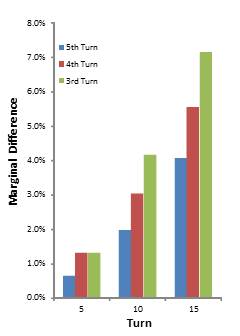
This analysis will compare decks that search often to a deck that has no search cards.  The latter deck will be called the Fat One because you can call a deck fat without being thought of as insensitive.  Like a good economist, I must make a few artificial assumptions: 

  1. The output will be the chances of drawing an unsearchable, limited card like Raigeki.
     
  2. All decks except for the Fat One will open with a search card. After that, the decks will draw into a search card every x number of turns. This variable will define the other decks.  We will look at decks that draw a search card every 3, 4, and 5 turns.  

This analysis shows that “deck thinning” has rather modest benefits (Fig 1).  For example, the Fat Deck gives you a 25% chance of drawing into your Raigeki by turn five.  These odds increase to 26.3% if you play a deck that searches with every third card.  In other words, if you have between 13 and 14 search cards, you will increase your chances of drawing a limited card by 1.3%. By turn ten, your odds will increase by 4.2% (Fig 2)
 
Figure 2
Of course, real life is more complicated.  The current top decks have cards that search multiple times.  Qliphart Scout can search every turn.  Still, the advantage of this card is in what it searches for and not the amount that it thins the deck.  

Here are my conclusions:
  1. The advantages of “Deck Thinning” are relatively modest. 
  2. Deck thinning only improves your odds late in the duel.
  3. Cards that do little more than “thin your deck” are not worth playing.  This includes cards that search for cards you don’t need.  

Monday, January 5, 2015

Saving the Stars: The Future of Satellarknights

I have had more success with Satellarknights than with any other deck.  This weekend, I won 10 packs and pulled a Virgil – not bad for a knight’s work.  Still, my faith in the deck is pretty limited.  Let’s be clear: Doolists taking this deck into a major tournament are going with an underdog.  

I'm going to spend two weeks with my head in the stars.  This week's post will focus on the main deck.  Next week, I will look at extra and side deck choices.   

Tell Tale Problems
While Tellarknights shine in their ability to search and recur, they have few significant drawbacks.  First, they run a ponderous number of traps.  Meanwhile, Shaddoll’s and Qlipharts are moving on to near trapless editions.  Even Burning Abyss decks are shedding traps as demonstrated by Jake Phinney’s six-trap wonder deck at ARG Orlando.   

While powerful, traps are inherently slow cards that are great at preventing problems.  Seeing red when you’re going first is a wonderful experience.  However, they do a poor job of getting you out of jams.  Bottomless is a fine card but not when there is a scrap yard’s worth of Qlips on the field. 

Qliphart rising has also ushered in the great age of set card destruction.  Some Qlip players in Orlando were playing triple MST and triple Night Beam.  This type of one-for-one destruction hurts Tellar players greatly since a significant portion of their card advantage comes from COTH and Oasis. Compare this mechanic to Shaddoll and BA players whose advantage comes from sending cards to the graveyard. If this trend weren’t enough, enter Denko Sekka who can single-handedly shut down 40% of your deck. 

The second problem is the deck’s reliance on normal summoning.  This idea has quickly evolved from sophisticated concept to bandied buzzword.  Of the major meta decks, Tellars are burdened the most with this criticism, which is ironic since Tellars are also the first archetype to get their effects regardless of the manner in which they are summoned.  From a mechanic standpoint, their effects are completely independent from normal summoning. However, this term really refers to the ease of special summoning.  Compared to Harpies and Samurais, Tellars are not so normal summon dependent. However, the label is well deserved for a deck whose set up is 3 turns longer than the rest of the meta. 

The third problem is their vulnerability to destruction.  Creating a wall of Satellarknights takes planning and several turns.  Knock it down with Dark Hole and the Tellar doolist will have to start all over again. This experience is dramatically different in for the BA player.  Activating Dark Hole can give them card advantage.  Now that Dark Hole is at two, I fear our little walls will be knocked into dust. 

Mini Makeover
For those of you who still wish to reach for the stars, here are a few principles that I try to incorporate into my builds:

Honest is essential.  I am happy to tell any purist to get over their righteous indignation and play the card.  If Qlipharts can main Limiter Removal, we can play two Honests.  In fact, I will sometimes “accidently” reveal my Honest while shuffling in order to enhance my bluffs.  I’ve had opposing doolists book a lone Alsahm in order to play around a potential Honest.

Bait out the destruction.  My trap lineup is a bit different.  With the exception of Nova, they are all continuous*.  They are not reactive with the possible exception of Emptiness.  Furthermore, they usually require a response.  This is why I dropped Fiendish Chain for Battleguard Rage. I can put a 2800 point monster on the field without special summoning leading most Shaddoll players to burn a MST to stop it.  I’m fine with that play since the goal is to protect COTH and eventually reuse it with Triverr. Of course, the card is not without risk, since popping the monster will leave you at a neg 1.  Nevertheless, it's time for a little out of the box thinking.

Limit the dead cards.  This deck does not have the liberty to brick.  Drawing Altair without cards in the graveyard gives you an Axe Raider. This is why I play Foolish Burial.  Between the COTHs, Oases, and Altiers, Foolish is never dead.

Don’t forget Thrasher.  Photon Thrasher is really a pumped up Vega.  Sure, you can’t summon him when you have board presence, but that’s not the time you need help.  I have found him most useful in getting rid of a defense position Burning Abyss monster.  By doing so, Fire Lake is often dead and I can proceed with the rest of my set up.  He also swings easily over Dinko Sukka.

3 Satellarknight Deneb 
3 Satellarknight Altair

3 Satellarknight Unukalhai

1 Satellarknight Vega

1 Satellarknight Alsahm

2 Photon Thrasher

2 Honest


3 Reinforcement of the Army

2 Mystical Space Typhoon

2 Satellar Skybridge (or Forbidden Lance)

1 Snatch Steal

1 Foolish Burial

3 Magic Planter


3 Stellarnova Alpha

3 Call of the Haunted

2 Oasis

3 Vanity’s Emptiness

2 Battleguard Rage


*Hence,  Magic Planter is nearly always live - at least until Dark Law comes out.

Maxi Makeover
For the most part, the fixes given above are not particularly radical.  We are still a long ways from the 6 trap deck.  Here is my attempt to build of such a Satellar Deck:   

3 Satellarknight Deneb

3 Satellarknight Altair

2 Satellarknight Unukalhai

2 Satellarknight Vega

2 Satellarknight Alsahm

1 Satellarknight Procyon

2 Photon Thrasher

2 Honest


3 Reinforcement of the Army

2 Mystical Space Typhoon

3 Satellar Skybridge

1 Snatch Steal

1 Magnum Shield

2 Hidden Armory

1 Soul Charge

3 Enemy Controller

1 Raigeki


3 Stellarnova Alpha

3 Call of the Haunted


This deck still requires some tweaking.  I am not sure if triple E Con and Skybridge are a good idea.  Forbidden Lance and Chalice may be reasonable alternatives.  That said, this deck feels like a Satellar deck that is trying to be a Shaddoll deck.  While Diamond has blown some life into the price of Deneb, I remain rather pessimistic about this archetype as a whole. 

Nevertheless, the stars have been good to me and for that reason I will continue to play it.

For those of you who aren’t astronomers by trade, here’s a pronunciation guide:

Altair: AL - tair

Alsahm: AL - sahm

Betelgeuse: BET-el-jooz

Deneb: DEN-ebb

Procyon: PRO-see-on

Rigel: RYE-jel

Sirius: SEER-ee-us

Unukalhai: uh-NOO-kul-lye

Vega: VEY-ga

Tuesday, December 30, 2014

Pre-season rankings for 181 Yugioh Archetypes


We are on the eve of a New Year and playas and pundits alike are making their predictions.  Traditionally, the Yugiverse has done the same in response to the F & L list.  Alas, that vaunted list has little influence on the meta.  The modern game is dominated by the release of evermore powerful archetypes. 

Over the next three fortnights, Konami will disgorge themselves of Secrets of Eternity, Hero Strike, and Secret Forces.  While SECE will cause only minor ripples, Hero Strike and Secret Forces will cause seismic shifts in the game.  Heroes return with a searchable Macro Cosmos and the Secret Forces will establish the primacy of Nekroz with their reincarnate Trishula.  Furthermore, these latter sets will be readily accessible.  While I decry the haste of their release, I am grateful that these cards will be affordable to most doolists.  All of the investors in Burning Abyss should be prepared to get burned by a bargain deck.

My quarterly lists remain popular posts and seem to garner the most comments.  Commenting on eBlogger is cumbersome and not reader friendly.  I suspect more try than succeed.  Nevertheless, I will try to post any comment that is not vulgar as quickly as possible.  That said, one should realize this list is a somewhat ironic statement about the nature of prediction in general.   Preseason polls are little more than fodder for barroom conversation. My list is also intended for such conversations whether they take place in bars or elsewhere.

This list was made with the following observations:
  1.  I am including Secrets of Eternity and Hero Strike but not Secret Forces.  In other words, this list is a prediction of the meta until February 12th.  This choice is somewhat random but it reflects my desire to prepare for YCS South Carolina on February 1st.
  2. Graveyard dependent decks will get hit.   Dark Law will be the new law in town.
  3. Light themed decks will trend up slightly with Honest at two.
  4.  Several lower tiered decks will get a small boost from SECE.  Unfortunately, none of this additional support will move these decks into competitive contention.  However, they should inject a little bit of fun into some beloved archetypes. This list includes X Sabers, Zombies, Symphonic Warriors, Dragunities, and winged beast themed decks.
  5.  Be wary of two rogue strategies!  Monarch support has been slowly increasing over the past year.  The less dependent monarchs are on the little froggy, the better they will be.  I also think Koa’ki Meiru Overdose will add greatly to the Rock Stun strategy.
A few notes on this list:
  • The larger numbers on the left are my predictions for the first 4 - 6 weeks of the meta. 
  • The smaller numbers on the right were my predictions following the last F&L list.
  •  I update this list with the institution of each new F&L list.  I do not delete my older posts.  
  • I have dropped my tongue and cheek tier ratings since this seems to be a point of contention among the Yugioh faithful.
  • ... and yes, please tell me why Gimmick Puppets should leap above Galaxy.