Monday, January 19, 2015

Saving the Stars: Extra and Side Deck Choices


Long time readers of this blog may have noticed the recent scarcity of large tournament reports.   Scheduling has been one reason for this hiatus.  Unfortunately, Konami did not consult me before announcing their regional dates.  I also admit to becoming a little disenchanted with the game during the fall.  The newer archetypes power crept their way over our old friends.  All of us were forced to adapt or lose.  Sadly, age has a way of making the former hard and the latter familiar. 

My faith and fortunes have been slowly reversed by the Satellarknights, which is why so much time is dedicated to the archetype.  Though becoming YCS champion is a bit of a stretch, I have gained enough confidence to march proudly into the South Carolina and show them young ‘uns and thing or two. If all goes well, I will take the stars into the second day. 

Last week, I described a more traditional build and a faster “trap-light” build.  My current build is actually an amalgam of both.  This week, I will give my choices for the extra and side deck.      


Extra Deck: Here is the list of cards that I am currently playing
  • Diamond x 1: The card’s title sounds like a “Name Game” reject.  Nevertheless, it’s a Tellar player’s answer to two legs of the golden triangle.  Now, if they would only make one of these things for earth monsters.
  • Triverr x 2: This card is the deck’s lifeguard who says “Everyone out of the pool”.  Given the continued problems with destruction, he’s worth two slots.
  • Delteros x 1: This card’s 2500 attack has always made it an asset to the deck.  The card’s stock has risen with the Diamond revolution.
  • Castel x 2: Double Castel has become rather standard in rank four toolbox decks.  It’s not netdecking – it’s smart.
  • Diamond Dire Wolf x 1: Detaching and tributing itself is a common but rather awful move.  It’s in simply because it has some synergy with Castel. 
  • Ragnazero x 2: My current build focuses on summoning rank four XYZ’s on turn one.  The main reason for doing so is this card’s effectiveness against Qlips.
  • Gandiva x 1: The rationale for this card is similar to Ragnazero, except that it used match-ups against BA and other Tellar players.
  • Excalibur x 1: This cards 4000 attack gives Tellars a fighting chance against Qlipharts.  It’s so important that I have considered running two. 
  • Heartland Draco x 1: This card is taking the place of a second Excalibur.  It gets over Killer and allows Flying “C” to stay on the field. 
  • Abyss Dweller x 1: Shutting down graveyard effects is key against BA.  Often times you only need to do it once.
  • Exciton x 1: Using this card is like making a deal with a loan shark.  You know it will be expensive, but you’re desperate.
  • Cowboy x 1: The 800 burn can keep your opponent from activating Solemn Warning, Skill Drain, or Scout. 
Honorable Mention: Here are cards that didn’t quite make the cut.
  • Cairngorgon, Antiluminescent Knight: Every time a carrier returns one of my monsters, I wish I played this card.  It also gets over Majesty’s Fiend.  Currently, it’s in the side because it can’t get over Dante.  Nevertheless, it’s the closest to getting put back into play.
  • Daiguisto Emeral: The main reason I may add this card back is its ability to recycle XYZ monsters. A second Abyss Dweller could come in handy. However, if I have the time for such a play, I usually don’t need to. 
  • Silent Honor Ark: One day I woke up and realized I never used this card.  It was hard to believe since it has been a stable in my rank four builds since its release.  Slowly but surely, the little musketeer has defeated the .. uh … whatever it is.
  • Starliege Paladynamo: Why did I take this out?  This is a good card but other cards do slightly more.  For example, Castel is probably a better choice.   
  • Constellar Omega: The trend towards fewer traps has made this card less useful. More importantly, it loses to Dante each time.
  • Bujintei Tsukuyomi: This is a popular card among Tellar players. It's another that may be back in before the YCS.
  • Rhapsody in Beserk: Very few of the current decks are crippled by removing two cards.  The equipping effect is a nice boost but it means getting at least one other XYZ monster on board.  This has become a difficult task even for Tellars.
  • Crazy Box: This card would have to have a 4000 attack to be viable.   
  • Dark Rebellion XYZ Dragon: It’s not bad but I would rather have Excalibur. 
As I have mentioned before, side deck cards work best at three.  However, making such a side deck can be a challenge. Here’s my version of the perfect side deck.

Side Deck: Here are the cards I am currently playing:
  • De-Fusion x 3: This card gets a boost with the rise of Dark Law. 
  • Shadow Imprisoning Mirror x 3:  This continuous trap fits into the overall strategy of my build. 
  • Mask of Restrict x 3: Just when I thought I got a handle on Qlips, they got better. This card is my latest strategic attempt to slow them down.  Without tributing, the deck becomes mostly an 1800 attack point spam deck.
  • Fairy Wind x 3: This is still the most effective card against Qlipharts.
  • Flying “C” x 3:  As the meta speeds up, hand traps become more valuable.  I think this card is the most useful against the mirror match and BA.
Honorable Mentions
  • Burial from a Different Dimension: I am seriously considering putting this card in for the Hero match-up.  However, it is limited and my odds for drawing into it are too low.
  • Maxx “C”: I have tried both roachs and currently prefer the flying kind. Maxx C is not so effective if you have nothing to draw into that will stop the game.
  • Fire and Ice Hands: This is a popular choice in the OCG.  However, I found that Carrier would simply put it back in your hand. 
  • Spell Shattering: This is a good card and it gets around Night Beam. However, it won’t stop Skill Drain.
  • System Down: By the time you plus off this card, the duel is over.
  • Dark Hole: Most of the meta seems to care little about destruction.
  • Creature Swap: This card was in my side deck for most of the fall and early winter.  I dropped it for E Con when decks put out too many monsters to make the card viable.  Now all I have to do is make sure I don’t play noble knights.
  • Magnum Shield: I still like this card’s ability to add muscle to nearly all of my monsters.  One of these days, I will combine this card with Hidden Armory. 
Slightly less Honorable Mentions:
Forbidden Chalice, Forbidding Lance, Breakthrough Skill, Skill Prisoner, Stygian Dirge, Rivalry, Mind Crush, and others have all been in my side deck for at least a duel or two.  All have their place though I think you will find these to be less helpful. 

In only two more weeks, I will take six other intrepid doolists to the shores of South Carolina.  Report to follow!  

Here is the current list: 
3 Satellarknight Deneb 
3 Satellarknight Altair 
3 Satellarknight Unukalhai
1 Satellarknight Vega
1 Satellarknight Alsahm
1 Satellarknight Rigel
2 Photon Thrasher
2 Honest

3 Reinforcement of the Army
2 Mystical Space Typhoon
2 Satellar Skybridge
2 Enemy Controller
1 Snatch Steal
1 Foolish Burial
1 Raigeki

3 Stellarnova Alpha
3 Call of the Haunted
2 Oasis
2 Vanity’s Emptiness
2 Skill Prisoner

Thursday, January 15, 2015

After You: Going Second in Yugioh


Yugioh used to be a simple game.  If you won the dice roll, you went first.  If you lost, you had an excuse for losing.  

Today’s game has changed that simple formula.  Many clever doolists are deferring their turn and letting their opponent go first.  Since Yugioh players are not known for their manners, there must be a reason for this sudden rise in courtesy.

Choosing to go first or second has become a complex decision.  Doolists need to consider what is advantageous to their deck as well as what may be detrimental to their opponent’s deck.  This decision can be facilitated by understanding the advantages of going first or second.  I categorize these advantages as follows: 

  • Card advantage
  • Board Advantage
  • Attack Advantage

Card advantage is pretty basic.  Players going first get five cards and those going second get six.  This difference means your chances for drawing a limited card increase by 2.5%.  In other words, players going second will benefit from an early Raigeki in one game in 40.  This advantage is greater for decks that run search cards. If Tellarknight players run three Deneb and three ROTA, their odds of opening with Deneb increase by 7.2% or one game in 13.  All of the top meta decks benefit from this phenomenon, but, it may make the biggest difference to Qliphart players.  Most will tell you that their deck is more consistent when going second as these numbers suggest.  

Board advantage is the advantage that comes from getting your cards on the matt first.  In general, this advantage goes to the player going first in exchange for card advantage lost to the player going second.  Trap heavy decks benefit the most from board advantage.  In fact, I suspect this rule change was prompted by the dreaded “Laggia/set four” combination seen at the height of the Dino Rabbit era. 

This advantage is being diminished by the recent reduction in traps by the top decks. While Burning Abyss and Qlipharts have become nearly trap independent, the board advantage calculus has been changed the most by Shaddolls.  This deck actually gains board advantage from going second, particularly if the opponent unwittingly opens with a special summoned monster.  In short, the Shaddolls gain both card and board advantage by going second.  While this deck may be the best at combining board and card advantage, other decks can do so as well by maining cards like Enemy Controller and Snatch Steal.   

Attack Advantage is the ability to do life point damage first.  In the past, this advantage was relatively small since the game focused on managing life points rather than crushing them. The Qlipharts have changed this prescription a bit.  Their attacks are so massive and so quick that “managing” life points is like bailing out the Titanic.  While most opponents will have the resources to deal with the deck, gathering these resources takes time.  By going second, Qlip players can make sure these resources are never amassed. 

Given the choice, I will almost always go second despite using a trap heavy Satellarknight deck.  I mitigate the loss of board advantage by leaving out cards that are good openers but are poorer responders.  For example, I play Enemy Controller instead of Bottomless Trap Hole.  Nevertheless, the deck does have better first turn plays than most of the competition.  So I’ll summon Deneb, set two, and say “Go”.

Monday, January 12, 2015

Putting Your Deck on a Diet


As a cancer doctor, one would think I would be protected from discussing dieting with patients.  After all, cancer is associated weight loss and not obesity, right?  

Figure 1
Not so.  In fact, many of my patients survive their cancer only to face the same weight problems they had before their diagnosis.  As a result, talking about dieting has become a part of my normal practice.  Fortunately, dieting for a Yugioh deck is much easier as long as you think of deck thinning as a form of deck dieting.  

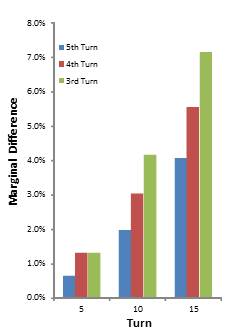
Deck thinning is the process of increasing your odds of drawing a card by decreasing the pool of remaining cards in your deck.  This naturally happens when you search for a card.  Not only do you get the card you want, but you increase the chances of drawing one of the remaining unsearchable cards. Some cards serve no other purpose but to “thin the deck.”  Upstart Goblin remains popular though there are others like Jar of Greed. 

How much advantage is there to deck thinning?

This analysis will compare decks that search often to a deck that has no search cards.  The latter deck will be called the Fat One because you can call a deck fat without being thought of as insensitive.  Like a good economist, I must make a few artificial assumptions: 

  1. The output will be the chances of drawing an unsearchable, limited card like Raigeki.
     
  2. All decks except for the Fat One will open with a search card. After that, the decks will draw into a search card every x number of turns. This variable will define the other decks.  We will look at decks that draw a search card every 3, 4, and 5 turns.  

This analysis shows that “deck thinning” has rather modest benefits (Fig 1).  For example, the Fat Deck gives you a 25% chance of drawing into your Raigeki by turn five.  These odds increase to 26.3% if you play a deck that searches with every third card.  In other words, if you have between 13 and 14 search cards, you will increase your chances of drawing a limited card by 1.3%. By turn ten, your odds will increase by 4.2% (Fig 2)
 
Figure 2
Of course, real life is more complicated.  The current top decks have cards that search multiple times.  Qliphart Scout can search every turn.  Still, the advantage of this card is in what it searches for and not the amount that it thins the deck.  

Here are my conclusions:
  1. The advantages of “Deck Thinning” are relatively modest. 
  2. Deck thinning only improves your odds late in the duel.
  3. Cards that do little more than “thin your deck” are not worth playing.  This includes cards that search for cards you don’t need.  

Monday, January 5, 2015

Saving the Stars: The Future of Satellarknights

I have had more success with Satellarknights than with any other deck.  This weekend, I won 10 packs and pulled a Virgil – not bad for a knight’s work.  Still, my faith in the deck is pretty limited.  Let’s be clear: Doolists taking this deck into a major tournament are going with an underdog.  

I'm going to spend two weeks with my head in the stars.  This week's post will focus on the main deck.  Next week, I will look at extra and side deck choices.   

Tell Tale Problems
While Tellarknights shine in their ability to search and recur, they have few significant drawbacks.  First, they run a ponderous number of traps.  Meanwhile, Shaddoll’s and Qlipharts are moving on to near trapless editions.  Even Burning Abyss decks are shedding traps as demonstrated by Jake Phinney’s six-trap wonder deck at ARG Orlando.   

While powerful, traps are inherently slow cards that are great at preventing problems.  Seeing red when you’re going first is a wonderful experience.  However, they do a poor job of getting you out of jams.  Bottomless is a fine card but not when there is a scrap yard’s worth of Qlips on the field. 

Qliphart rising has also ushered in the great age of set card destruction.  Some Qlip players in Orlando were playing triple MST and triple Night Beam.  This type of one-for-one destruction hurts Tellar players greatly since a significant portion of their card advantage comes from COTH and Oasis. Compare this mechanic to Shaddoll and BA players whose advantage comes from sending cards to the graveyard. If this trend weren’t enough, enter Denko Sekka who can single-handedly shut down 40% of your deck. 

The second problem is the deck’s reliance on normal summoning.  This idea has quickly evolved from sophisticated concept to bandied buzzword.  Of the major meta decks, Tellars are burdened the most with this criticism, which is ironic since Tellars are also the first archetype to get their effects regardless of the manner in which they are summoned.  From a mechanic standpoint, their effects are completely independent from normal summoning. However, this term really refers to the ease of special summoning.  Compared to Harpies and Samurais, Tellars are not so normal summon dependent. However, the label is well deserved for a deck whose set up is 3 turns longer than the rest of the meta. 

The third problem is their vulnerability to destruction.  Creating a wall of Satellarknights takes planning and several turns.  Knock it down with Dark Hole and the Tellar doolist will have to start all over again. This experience is dramatically different in for the BA player.  Activating Dark Hole can give them card advantage.  Now that Dark Hole is at two, I fear our little walls will be knocked into dust. 

Mini Makeover
For those of you who still wish to reach for the stars, here are a few principles that I try to incorporate into my builds:

Honest is essential.  I am happy to tell any purist to get over their righteous indignation and play the card.  If Qlipharts can main Limiter Removal, we can play two Honests.  In fact, I will sometimes “accidently” reveal my Honest while shuffling in order to enhance my bluffs.  I’ve had opposing doolists book a lone Alsahm in order to play around a potential Honest.

Bait out the destruction.  My trap lineup is a bit different.  With the exception of Nova, they are all continuous*.  They are not reactive with the possible exception of Emptiness.  Furthermore, they usually require a response.  This is why I dropped Fiendish Chain for Battleguard Rage. I can put a 2800 point monster on the field without special summoning leading most Shaddoll players to burn a MST to stop it.  I’m fine with that play since the goal is to protect COTH and eventually reuse it with Triverr. Of course, the card is not without risk, since popping the monster will leave you at a neg 1.  Nevertheless, it's time for a little out of the box thinking.

Limit the dead cards.  This deck does not have the liberty to brick.  Drawing Altair without cards in the graveyard gives you an Axe Raider. This is why I play Foolish Burial.  Between the COTHs, Oases, and Altiers, Foolish is never dead.

Don’t forget Thrasher.  Photon Thrasher is really a pumped up Vega.  Sure, you can’t summon him when you have board presence, but that’s not the time you need help.  I have found him most useful in getting rid of a defense position Burning Abyss monster.  By doing so, Fire Lake is often dead and I can proceed with the rest of my set up.  He also swings easily over Dinko Sukka.

3 Satellarknight Deneb 
3 Satellarknight Altair

3 Satellarknight Unukalhai

1 Satellarknight Vega

1 Satellarknight Alsahm

2 Photon Thrasher

2 Honest


3 Reinforcement of the Army

2 Mystical Space Typhoon

2 Satellar Skybridge (or Forbidden Lance)

1 Snatch Steal

1 Foolish Burial

3 Magic Planter


3 Stellarnova Alpha

3 Call of the Haunted

2 Oasis

3 Vanity’s Emptiness

2 Battleguard Rage


*Hence,  Magic Planter is nearly always live - at least until Dark Law comes out.

Maxi Makeover
For the most part, the fixes given above are not particularly radical.  We are still a long ways from the 6 trap deck.  Here is my attempt to build of such a Satellar Deck:   

3 Satellarknight Deneb

3 Satellarknight Altair

2 Satellarknight Unukalhai

2 Satellarknight Vega

2 Satellarknight Alsahm

1 Satellarknight Procyon

2 Photon Thrasher

2 Honest


3 Reinforcement of the Army

2 Mystical Space Typhoon

3 Satellar Skybridge

1 Snatch Steal

1 Magnum Shield

2 Hidden Armory

1 Soul Charge

3 Enemy Controller

1 Raigeki


3 Stellarnova Alpha

3 Call of the Haunted


This deck still requires some tweaking.  I am not sure if triple E Con and Skybridge are a good idea.  Forbidden Lance and Chalice may be reasonable alternatives.  That said, this deck feels like a Satellar deck that is trying to be a Shaddoll deck.  While Diamond has blown some life into the price of Deneb, I remain rather pessimistic about this archetype as a whole. 

Nevertheless, the stars have been good to me and for that reason I will continue to play it.

For those of you who aren’t astronomers by trade, here’s a pronunciation guide:

Altair: AL - tair

Alsahm: AL - sahm

Betelgeuse: BET-el-jooz

Deneb: DEN-ebb

Procyon: PRO-see-on

Rigel: RYE-jel

Sirius: SEER-ee-us

Unukalhai: uh-NOO-kul-lye

Vega: VEY-ga